
Strength & Conditioning · Football
Strong Hamstrings. Slow Sprinter. What’s Missing?
The relationship between eccentric hamstring strength, sprint performance and injury resilience in football.
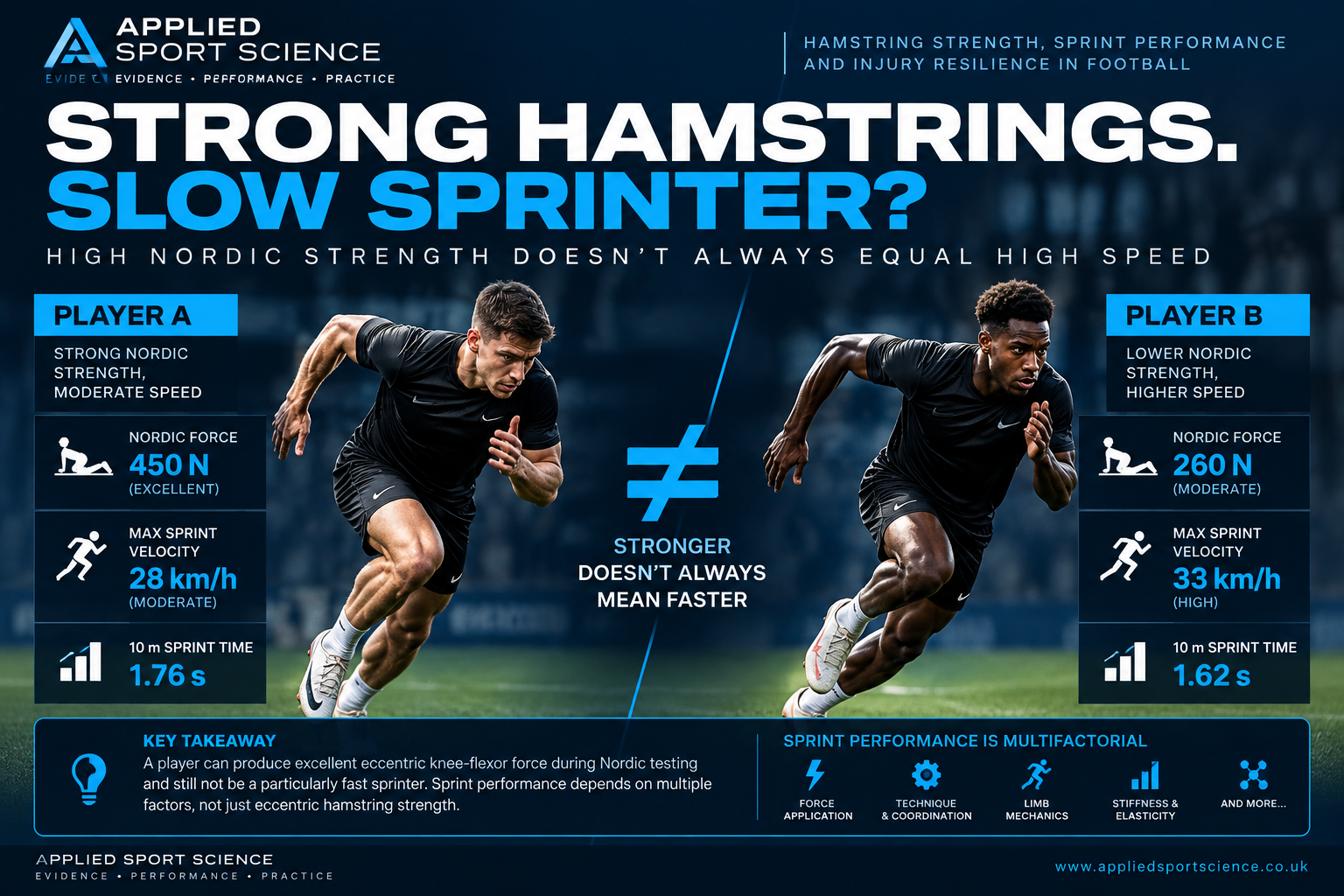
We spend a lot of time developing physical qualities in football: maximal strength, power, speed and eccentric hamstring capacity. But does getting stronger in one exercise improve the performance we actually want?
The Nordic hamstring exercise is now a familiar part of football strength and conditioning, and there are good reasons to use it. It can improve eccentric knee-flexor strength and muscle architecture, and programmes that include Nordics have been associated with fewer hamstring injuries.
But does the player with exceptional Nordic strength necessarily sprint faster? And can we assume that player is protected from injury? The relationship is more complicated. Developing a capacity, transferring it to performance and reducing injury risk are related questions, but they are not the same question.
What are the hamstrings doing during sprinting?
During high-speed running, the hamstrings experience substantial mechanical demands, particularly in late swing. As the thigh moves forwards and the knee extends, the hamstrings help control the lower leg and prepare the limb for ground contact.
This has traditionally been described as eccentric braking: the hamstrings actively lengthen while producing force to control rapid knee extension. But the muscle–tendon unit’s behaviour is more complex. Kalkhoven and colleagues’ 2023 review considered both this braking model and a proposed spring-like mechanism involving relatively isometric muscle fascicles. Their analysis supports a combination of muscle-fascicle behaviour and elastic tissue contributions, while noting that the precise contributions remain difficult to establish.
That uncertainty matters in the gym. A Nordic curl can provide a strong eccentric stimulus, but it does not reproduce the velocities, intermuscular coordination, joint mechanics or ground interactions of maximal sprinting. That is not an argument against Nordics; it is a reminder to be clear about what we are training.
Stronger hamstrings do not automatically mean faster players
Imagine two academy footballers. Player A produces excellent eccentric knee-flexor force in a Nordic test, has good general strength, and reaches 28 km/h. Player B produces considerably less Nordic force, has less structured strength-training experience, and reaches 33 km/h.
These are hypothetical examples, not real testing data. They show why a strength score cannot stand in for sprint performance. Acceleration and maximum velocity depend on how effectively an athlete produces and applies force in very short timeframes, alongside coordination, technique, limb mechanics and other neuromuscular qualities.
A Nordic test gives useful information about eccentric knee-flexor force under specific testing conditions. It does not tell us whether the player is an effective sprinter or how efficiently they apply force to the ground.
Bautista and colleagues’ 2021 meta-analysis included 17 studies. Nordic interventions showed a small pooled improvement in sprint time of about 0.04 seconds. The subgroup estimate was statistically significant at 10 metres, while results at 5 and 20 metres were not. The authors also noted risk-of-bias concerns, and strength improvements were less consistent in well-trained players.
There may be some transfer from Nordic training to sprint performance. The evidence does not justify expecting Nordic-force gains to produce proportional gains in sprint speed. Eccentric strength can be a useful capacity; whether it transfers depends on the rest of the programme and the athlete.
The injury-prevention evidence is encouraging, with context
The case for eccentric hamstring training is stronger when we look at injury-prevention programmes. Van Dyk and colleagues’ 2019 review pooled 15 studies involving 8,459 athletes. Programmes that included the Nordic exercise were associated with an overall hamstring-injury risk ratio of 0.49 compared with programmes without it.
That is a meaningful result and supports including Nordics in football preparation. It does not mean that an individual force score can reliably predict who will be injured. A player producing 450 N is not guaranteed to stay injury-free: they may face a sudden rise in sprint demands, fatigue, a previous injury or too little recent exposure to high-speed running. Conversely, a lower score alone does not mean a player is destined to get injured.
It is also useful to keep the evidence in perspective. A 2021 reappraisal challenged the certainty of the pooled injury-prevention estimate, pointing to methodological limitations in the evidence base. The practical case for Nordic training remains reasonable, but the size of the effect should not be treated as a personal guarantee or a complete risk-management strategy.
Eccentric strength is one piece of information in a much larger picture. Monitoring can become too focused on improving individual metrics without asking what those metrics mean for the player in front of us.
Longer fascicles are a useful adaptation, not a guarantee
Nordic training can also increase biceps femoris long-head fascicle length. Shorter fascicles have been associated with greater hamstring-injury risk in some prospective research, and a 2025 systematic review reported favourable fascicle-length adaptations following resistance training based on Nordics in soccer players.
Longer fascicles may contribute to the ability to tolerate mechanical strain. But fascicle length is not a direct measure of tissue failure resistance, and an increase does not guarantee that a player will avoid injury. Ultrasound estimates have limitations, and the extent to which structural changes translate into real-world injury outcomes remains an important question.
I see muscle architecture as a worthwhile training consideration alongside force capacity, sprint exposure and the player’s wider preparation.
The missing piece: high-speed sprinting
If we want footballers to tolerate high-speed sprinting, they need appropriate exposure to it. Small-sided games, technical practices and conditioning can add up to substantial running loads without taking a player near their maximum velocity. This matters particularly for substitutes, non-starters and players returning from injury.
A player might record plenty of total distance, high-speed running and accelerations yet never approach their individual maximum. If a wide player whose recorded maximum is 34 km/h has only reached 28 km/h in training recently, a match sprint at 33 km/h is a large change in the specific demand they have faced.
The issue may not be that their hamstrings are weak. They may have had too little recent exposure to near-maximal sprinting. Research by Malone and colleagues has discussed the importance of considering high-speed and peak-velocity demands in hamstring-injury prevention strategies. Still, the relationship between sprint load and injury risk is not linear or fully understood. More sprinting is not automatically better; exposure should be appropriate, progressive and individualised.
I would first ask why the exposure is missing and whether the programme should change. I would not prescribe maximal sprinting without considering injury history, recent workload, symptoms and training status.
Different methods make different contributions
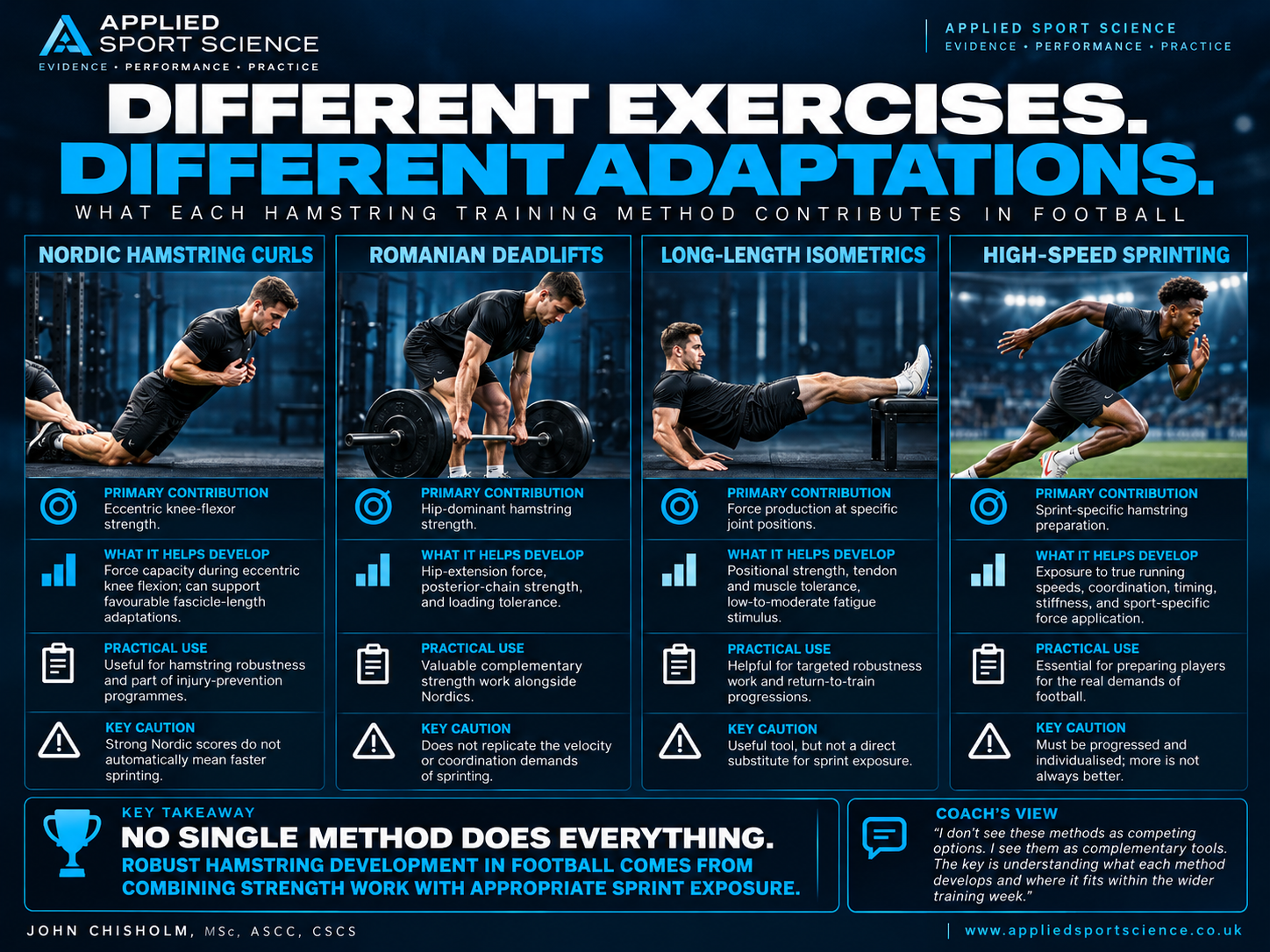
I do not see Nordic training, hip-dominant strength work, isometrics and sprinting as competing choices. Each contributes something different.
Eccentric knee-flexor strength
Nordic curls, assisted Nordics and progressive eccentric knee-flexion exercises develop knee-flexor force capacity under eccentric loading. For a player new to the exercise, I would start with a manageable dose and build capacity rather than add a high volume immediately. The aim is a useful stimulus without unnecessary soreness that compromises football training.
Hip-dominant strength
Romanian deadlifts, single-leg RDLs and other appropriately loaded hip-extension exercises offer a different stimulus and help develop the hamstrings’ contribution to hip-extension strength. I see these as complementary to Nordics, not replacements.
Isometric hamstring strength
Long-length hamstring bridge holds and well-positioned isometric knee-flexion exercises provide another way to develop force at selected joint angles. I would not claim that they perfectly reproduce what the hamstrings do in sprinting; that would go beyond the evidence I have seen.
High-speed sprint exposure
Progressive build-up sprints, flying sprints and position-specific high-speed running expose prepared players to the coordination, joint velocities and mechanical demands of the activity we are preparing them for. The volume, frequency and intensity should reflect training status, match exposure and individual needs. That specificity is difficult to replace.
What could this look like across a football week?
Here is one example for a fit player who is accustomed to strength training and regularly exposed to sprinting, in a Saturday-to-Saturday cycle. It is not a fixed prescription. Match minutes, recent sprint exposure, injury history, strength training and the player’s response all matter.
| Day | Possible hamstring emphasis |
|---|---|
| Sunday, MD+1 | Recovery for starters; compensatory work for non-starters. |
| Monday, MD+2 | Individualised strength work, particularly for players who need additional exposure. |
| Tuesday, MD-4 | Primary sprint exposure alongside lower-body strength. |
| Wednesday, MD-3 | Recovery or light individual work. |
| Thursday, MD-2 | Brief, low-fatigue high-speed or neural exposure where appropriate. |
| Friday, MD-1 | Avoid additional fatiguing hamstring work. |
| Saturday, MD | Match exposure. |
A regular starter who played 90 minutes and reached near-maximal velocity on Saturday needs a different MD+2 session from a substitute who played only 10 minutes. I also would not automatically add high-speed running on MD-2 if the player has already had an appropriate stimulus earlier in the week. The aim is not to tick off exercises or chase arbitrary sprint numbers; it is to provide what that individual needs.
How would I assess whether the programme is working?
I would consider several measures together rather than rely on Nordic force alone:
| Measure | What it helps me understand |
|---|---|
| Eccentric knee-flexor strength | Is force capacity improving, stable or declining? |
| 10 m and 30 m sprint performance | Are acceleration and longer sprint performance changing? |
| Maximum sprint velocity | What speed can the player currently achieve? |
| Individual sprint exposure | How often are they reaching meaningful percentages of their maximum? |
| Gym training history | Which knee- and hip-dominant strength stimuli are they receiving? |
| Availability and injury history | How are they tolerating their programme over time? |
If a player substantially improves Nordic strength but not sprint performance, I would not call that a failed strength programme. The strength intervention may have achieved what it was designed to achieve; I would then ask whether the wider programme addresses the player’s sprint-specific limitations.
Likewise, a better 30 m time alongside unchanged Nordic force is not necessarily a problem. Different qualities adapt at different rates and through different mechanisms. Small changes also need to be interpreted against testing reliability, measurement error and the player’s normal variation.
Capacity and performance are not interchangeable
The same principle applies throughout strength and conditioning. A player can have an impressive squat without being particularly explosive, or excellent countermovement-jump scores without outstanding change-of-direction performance. A player can also be very strong in a Nordic test without being especially fast.
None of this makes strength training irrelevant. It reminds us that performance is multifactorial. We need to understand which physical quality an exercise develops, which adaptation we want, and how that adaptation might contribute to performance or injury resilience.
The question is not simply, “How strong are this player’s hamstrings?” It is, “Have we developed the strength, speed and exposure this player needs to meet the demands of football?”
The Nordic remains a valuable part of my approach. Evidence supports including it in hamstring-injury-prevention programmes, while improvements in eccentric force capacity and muscle architecture provide further reasons to use it. But I would not expect improved Nordic strength to automatically make a player faster, or assume that excellent eccentric strength protects them from injury.
The priority is to develop the right capacities and prepare players for the demands they will face: evidence-informed strength work, progressive sprint exposure, individual monitoring and sensible programming.
References
- Bautista, I. J., et al. (2021). The effects of the Nordic hamstring exercise on sprint performance and eccentric knee flexor strength: A systematic review and meta-analysis of intervention studies among team sport players. Journal of Science and Medicine in Sport, 24(9), 931–938. doi:10.1016/j.jsams.2021.03.009
- Impellizzeri, F. M., McCall, A., & van Smeden, M. (2021). Why methods matter in a meta-analysis: A reappraisal showed inconclusive injury preventive effect of Nordic hamstring exercise. Journal of Clinical Epidemiology, 140, 111–124. doi:10.1016/j.jclinepi.2021.09.007
- Kalkhoven, J. T., et al. (2023). A conceptual exploration of hamstring muscle–tendon functioning during the late-swing phase of sprinting: The importance of evidence-based hamstring training frameworks. Sports Medicine, 53, 2321–2346. doi:10.1007/s40279-023-01904-2
- Malone, S., et al. (2019). Can the workload–injury relationship be moderated by improved strength, speed and repeated-sprint qualities? Journal of Science and Medicine in Sport. PubMed record
- Pecci, J., et al. (2025). Influence of resistance training variables and the Nordic hamstring exercise on biceps femoris architectural adaptations in soccer players: A systematic review. Sports Health. PubMed record
- van Dyk, N., Behan, F. P., & Whiteley, R. (2019). Including the Nordic hamstring exercise in injury prevention programmes halves the rate of hamstring injuries: A systematic review and meta-analysis of 8459 athletes. British Journal of Sports Medicine, 53(21), 1362–1370. doi:10.1136/bjsports-2018-100045