
Gathering data is not the same as proving it is beneficial for the player.
Even if an online football dashboard gathers masses of numbers, what is often less obvious is what to do with them!
All the GPS, wellness scores, session ratings and testing results will help describe what the player has done or what they think they are feeling, but collecting information is the easy bit. It only earns its place when it is looked at in reference to the player and their context and related to a decision or conversation.
First off. Research does not tell us how many metrics on a football dashboard change decisions. The "20" on the headline is a hint to look into our own practice. It's not a finding.
A metric has to pass more than one test
Now, I like to ask three different things of any monitoring metric:
Are values good enough for the actual use to which they are put?
Seeing it affect a decision?
Does the decision improve/protect any outcome that matters to the player?
They are related, but one does not answer the next. A reliable measure can still be the wrong tool for a particular decision. Information can change what we do without making things better. And a dashboard can be easy to read without being a validated decision-support system.
This line gets drawn clearly in a Frontiers Perspective from 2026 distinguishing "decision impact" as an entirely separate thing from evidence that resultant decision makes an athlete relevant positive-change (Besson and Stucky, 2026). It is a paper containing positions, NOT results. It is important as it challenges us with questions; upon what do we base our claims about our decision to use certain "actionable" monitoring systems?
What football research tells us
Evidence that monitoring information is used and valued in football. In a questionnaire study involving 176 coaches, players and performance staff in professional English football, respondents said that using GPS data could support reflection and practice. But the same study cited large quantities of information and a lack of common goals as being barriers to obtaining beneficial feedback (Nosek et al., 2021).
This is of relevance. But it is a survey on perceptions and reported practice. It does not establish whether such a dashboard might have led to greater decisions or better outcomes for players.
A similar picture emerges from a survey of the perceptions of coaches and support staff. While they generally valued monitoring to aid decisions, they typically saw it as only one component of a wider decision-making process rooted in professional judgement and communication (Timmerman et al., 2024). Again, perceptions do not mean that it is working!
Surveys and interviews are useful and important; the information obtained from them tell us how information is used and where communication has gone wrong. But they only give us the answer to a different question than an intervention study.
An association is not a decision rule
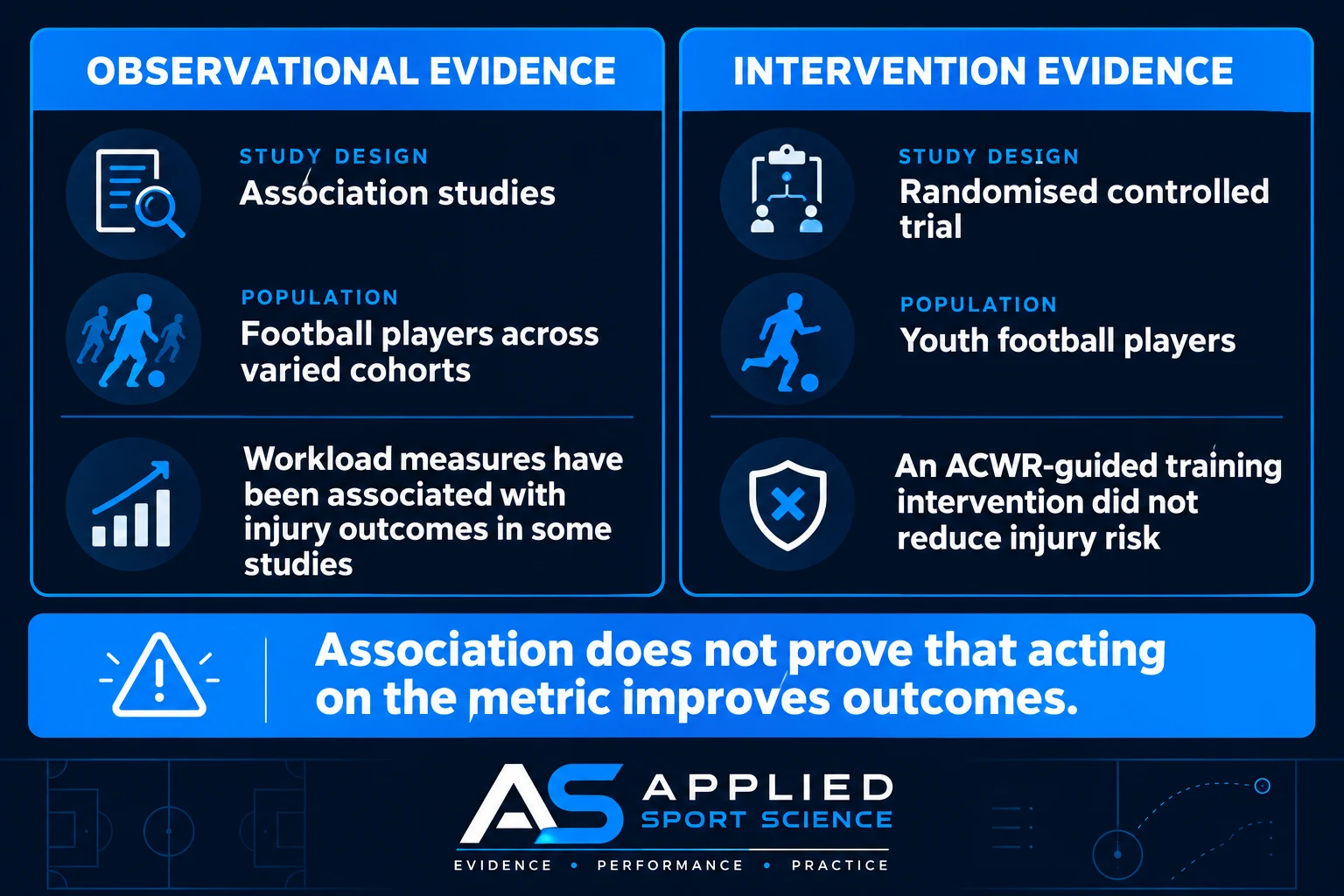
Workload and injury are often talked about together because there are studies in football that report links between workload patterns and injury. However, an association does not tell us whether changing someone's training based on one set of values will prevent an injury.
A major recent example is the ACWR - the acute: chronic workload ratio of training. A cluster-randomised trial looking at 482 elite youth footballers in England found no reduction in self-reported health problems during a season in teams applying an ACWR-led approach vs teams performing activity as usual (Dalen-Lorentsen et al., 2021). This is probably close enough to the gold standard to dismiss the idea that the ACWR works in this setting. For me though, none of this disproves monitoring and load-management per se.
The 2026 meta-analysis found an overall association between elevated ACWR and injury across team sports, but the heterogeneity between studies was huge. The association football subgroup was small and imprecise (Ding et al., 2026); the pooled result for time-loss injuries was null. We should not be selling this group result as a football threshold.
What the evidence says: "Some workload indicators relate to injury in some places and a single ACWR-guided trial in youth football did nothing to improve athlete health."
My reading: Workload data is definately an additional piece of information that contributes to (not leads) into the picture about injury risk. This data does not in itself serve as a reliable injury predictor let alone and/or an autonomic tool deciding training needs in individuals.
Prediction can point your attention. It doesn't prove benefit.
A recent study in elite women's football tested whether routine readiness, workload and wellness data could flag athlete-days more likely to be followed by a drop in self-reported readiness the next day (Long et al., 2026).
The model was tested on a later season held out from development. The authors pitched it as a way to help staff prioritise which athlete-days to review. They didn't show that staff changed their decisions, or that player management, performance or health improved. They also call for prospective testing and independent validation.
It's a good example of why the outcome matters. Predicting a reported dip in readiness is not the same as predicting injury. And neither shows that acting on the output helps the player!
Put context around the number
A number on a dashboard is not in itself accurate - GPS accuracy varies depending on the measure, device and manufacturer and changes in high-intensity measure may be real changes, may be normal match-to-match variation, or may be noise depending on the measure and how it was collected (Crang et al., 2022).
There is then all the stuff around it - position, minutes on pitch, session content, demands of the game/last matches, and what the player tells you. In Academy football, growth and maturation matter too - but all this would be guesswork which backs none of the dashboard rules up (Towlson et al., 2021).
Likewise, be careful moving research from one population to another. Do not sneak a threshold taken from male professional players into your youth or Women’s team analysis. They are different populations, the environments are completely distinct, and the literature bases are completely different.
When the subjective comes up in conversation it should be allowed its rightful place. In one systematic review self-reported measures were shown to be reactive to changes in training load and wellbeing. The evidence is varied across sports and just because some are responsive does not mean that the quality of information from a questionnaire is valid or honest (Saw et al., 2016). Trust matters here. If players don't know how their information will be used, or never hear what happened after they reported it, the quality of what they give you can drop.
A five-step dashboard audit
Here's a sequence I'd use to make the route from data to action visible - Measure, Interpret, Contextualise, Decide, Review.
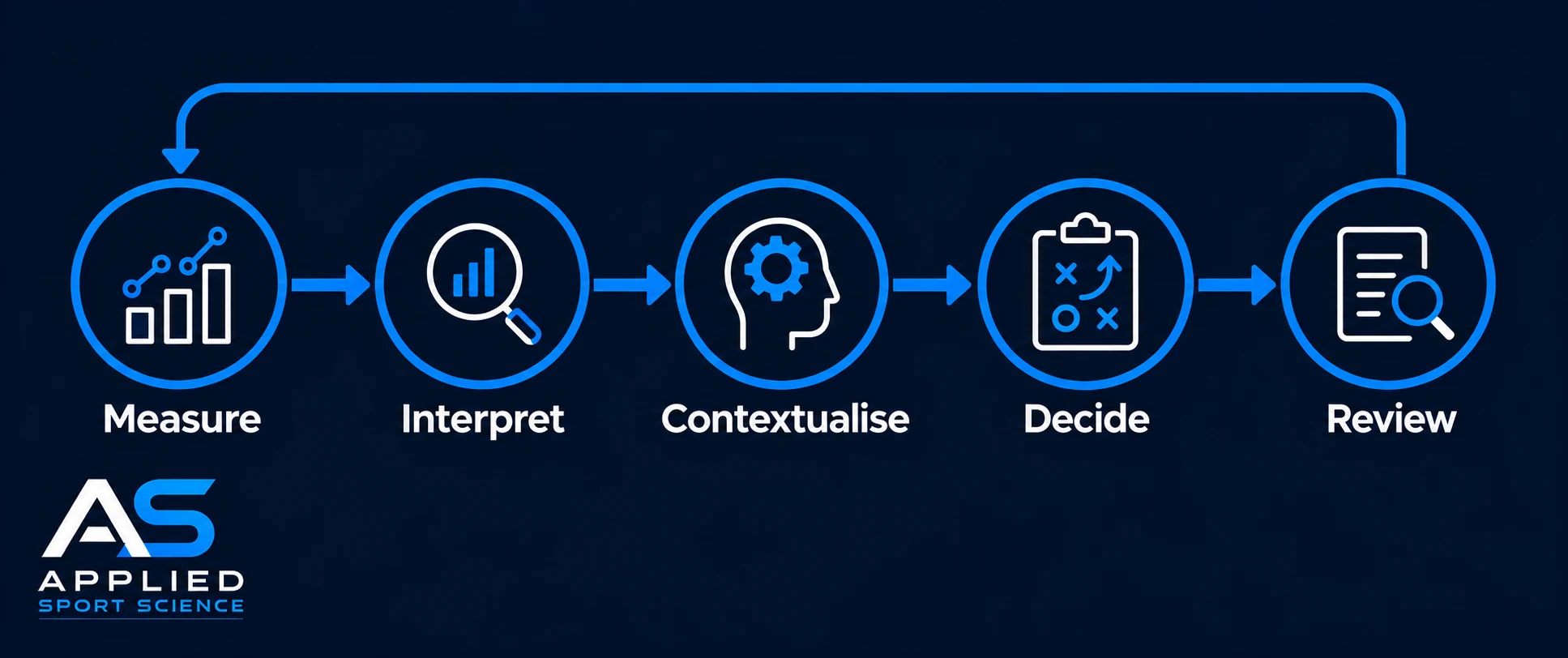
1. Measure. What does the metric actually record? Is it suited to the question? How reliable is it, and what's its normal variability?
2. Interpret. What might this value indicate, and what can't it tell us? Is the change meaningful, or within measurement error or ordinary variation?
3. Contextualise. What else matters for this player today? Training and match exposure, role, minutes, recent schedule, symptoms, maturity where relevant, and the player's own account.
4. Decide. What decision could this inform? A session adjustment, a conversation, further investigation, or keeping the plan. Doing nothing can still be an informed decision, as long as the information was considered and the reasoning is clear.
5. Review. Did it affect the decision? Was the action followed? What happened next? Was collecting and discussing the metric worth the time and burden?
This is a practical guide to organising thinking; not a validated monitoring intervention. Getting into the habit of recording simply for each metric whether it changed, confirmed, or qualified a decision and why, for a few months, will show you how you currently use your own system of metric.
The takeaway
The research doesn't tell us how many dashboard metrics are useful, or what share change decisions. What it does show is that collecting, measuring or displaying data is not the same as demonstrating decision impact or better outcomes.
For each metric, ask four things: what it measures, what context shapes its meaning, which decision it could inform, and how you'll review what follows.
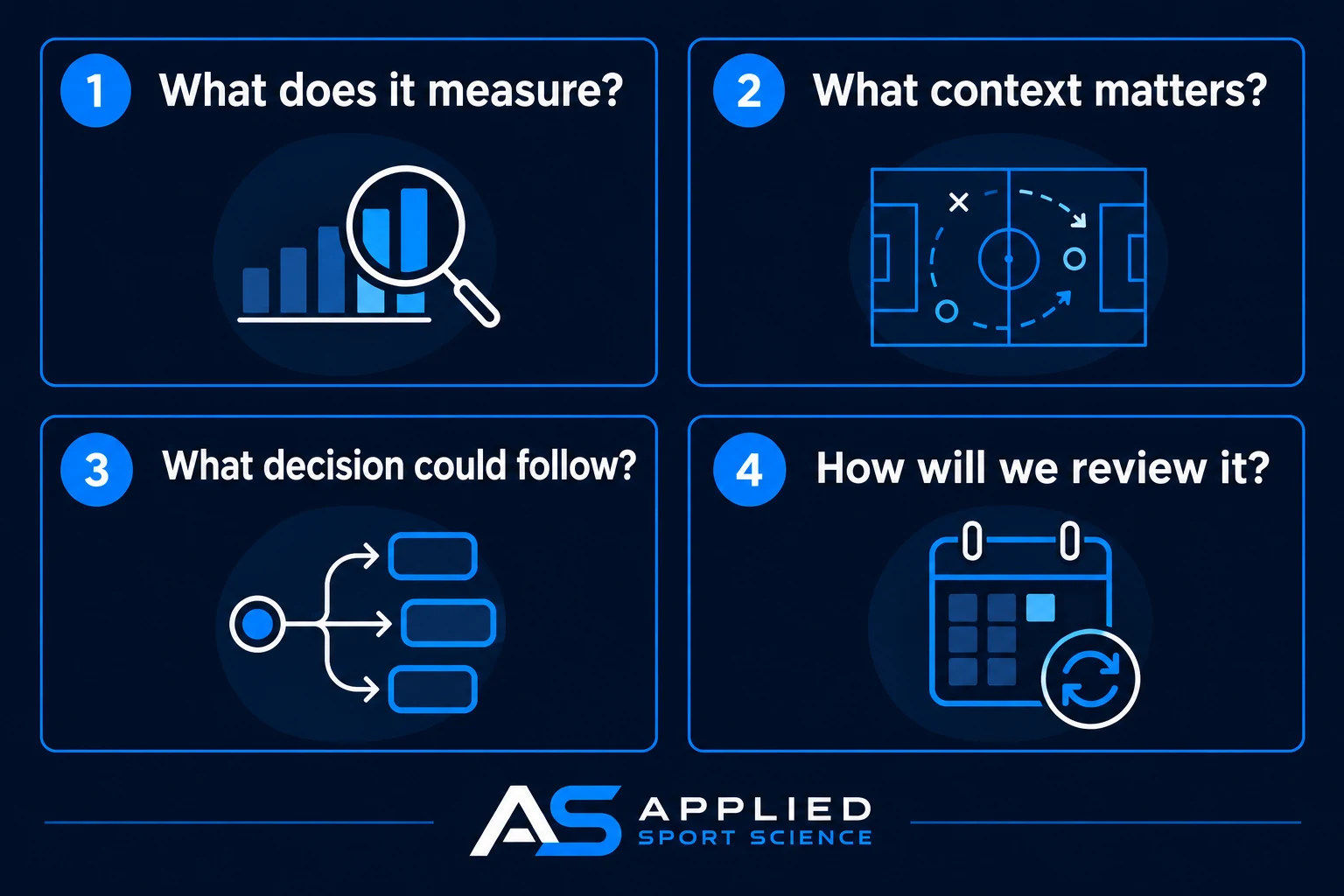
If there's no clear answer, the metric may still have value as context or for communication. Just be honest about that, and don't present it as proven decision support.
A metric earns its place on the dashboard by what it helps you decide, not by how easy it is to collect
References
- Besson, C. and Stucky, F. (2026). From monitoring metrics to decision evidence: validating actionability in applied sport science Frontiers in Sports and Active Living, 8, 1983979.
- Crang, Z.L. et al. (2022). The inter-device reliability of global navigation satellite systems during team sport movement across multiple days Journal of Science and Medicine in Sport, 25(4), 340–344.
- Dalen-Lorentsen, T. et al. (2021). Does load management using the acute:chronic workload ratio prevent health problems? A cluster randomised trial of 482 elite youth footballers of both sexes British Journal of Sports Medicine, 55(2), 108–114.
- Ding, L. et al. (2026). Acute:chronic workload ratio and load management for team sports: a multilevel meta-analysis Frontiers in Public Health, 14, 1896651.
- Long, H., Li, L. and Zhang, L. (2026). Prioritising next-day readiness decline in elite female soccer using readiness, workload, and wellness data PLOS ONE, 21(9), e0358036.
- Nosek, P., Brownlee, T.E., Drust, B. and Andrew, M. (2021). Feedback of GPS training data within professional English soccer Science and Medicine in Football, 5(1), 35–47.
- Saw, A.E., Main, L.C. and Gastin, P.B. (2016). Monitoring the athlete training response: subjective self-reported measures trump commonly used objective measures British Journal of Sports Medicine, 50(5), 281–291.
- Timmerman, W.P. et al. (2024). Athlete monitoring perspectives of sports coaches and support staff: a scoping review International Journal of Sports Science & Coaching, 19(4), 1813–1832.
- Towlson, C. et al. (2021). Maturity-associated considerations for training load, injury risk, and physical performance in youth soccer Journal of Sport and Health Science, 10(4), 403–412.