
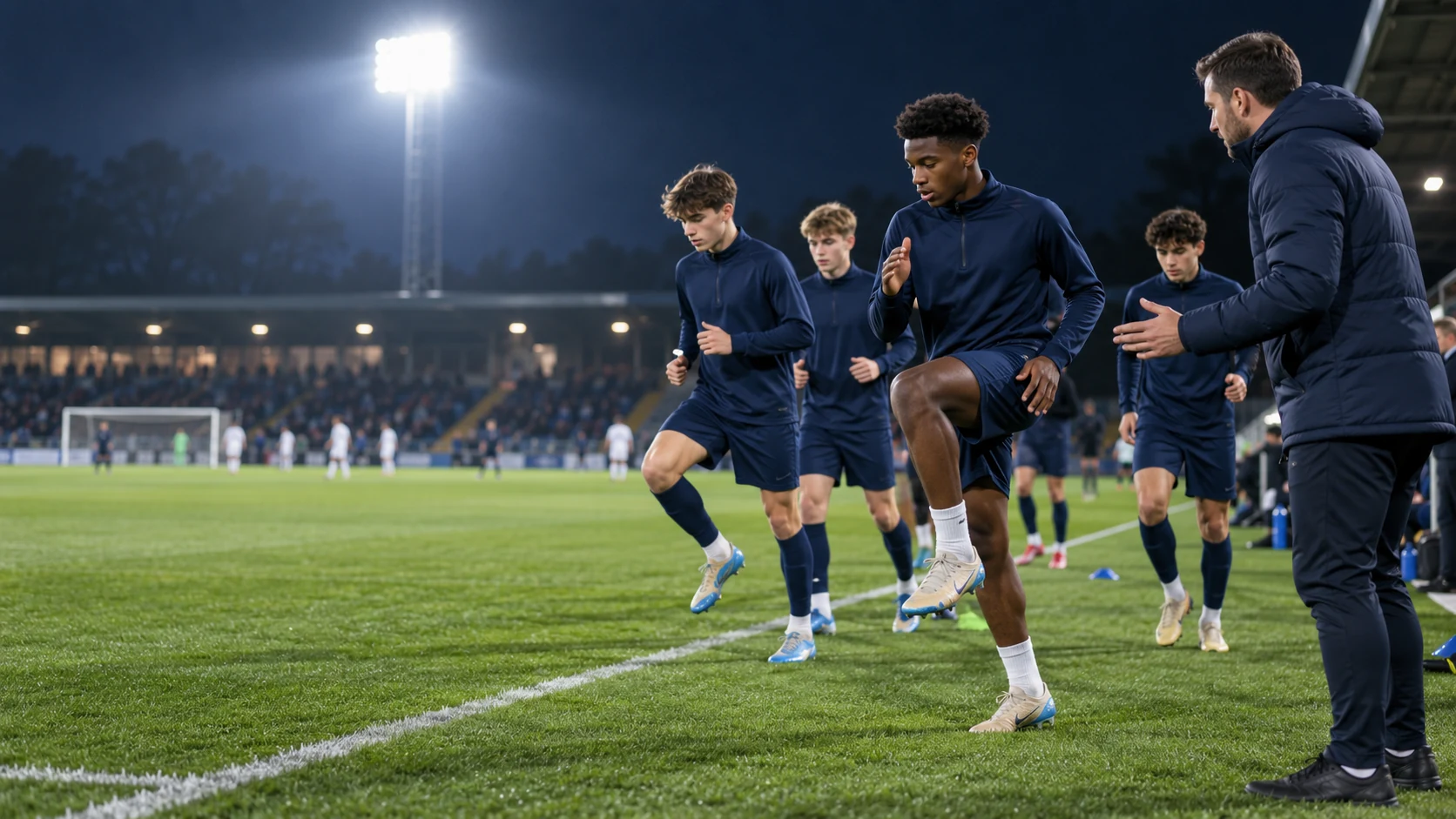
The halftime break of the game is probably as important to your athletes' muscles as your coach telling everyone that they are doing well.
What the science shows on halftime re-warmups, along with an accessible routine for academies to use.
A guide to halftime re-warmups and one academy coaches tried-and-true routine.
The half-time scenario often goes something like this: Once the team talk, treatment and half-time fluids are out of the way, players tend to spend a fair amount of time standing around in the dressing room. After several minutes, they then re-enter the field for the 2nd half re-start, with their bodies cooled to normal temperature, making them flat for the start of the second period. Bang, then the required intensity is ramped back up to game speed again!
My aim when designing a half-time plan for an academy club I consult with was to explore that question. "Can we keep the players warm and at a sufficient workload without detracting too much time and effort from the things that matter most at half-time?" was my initially enquiry.
There is some useful evidence around this topic, but no definitive routine will solve every challenge faced by every coach. I have developed a simple framework you could use to keep your players warm and focused without distracting them too much from their half-time duties.
What happens when players stand still
The effects of a passive break on a player's body are also well documented. Mohr and co-workers conducted a match study and saw that a player's thigh muscle temperature decreases by two degrees Celsius (~35.6 F). In this comparison, players who rested did perform worse in their sprint effort than did players who maintained movement at a low level.
So there is a coaching take for the whole interval. But with 16 people, we still are not going to use those percentages as predictors of other teams.
Yes, a subsequent study of professional soccer players came to similar conclusions. Players who took passive rest showed decreased sprint performance, along with diminished vertical and horizontal jump capabilities, in the first few minutes of the second half (Edholm et al., 2015). Those players who included a light re-warm-up while on the sidelines retained their sprinting abilities throughout the period and experienced only a moderate decline in jumping capacity. However, this routine didn’t improve every running measure across the match, which is a good reminder that feeling sharper at kick-off does not automatically mean a better second half.
My practical interpretation of this study is modest, that perhaps spending a few minutes performing motions players know could get players to the second half ready better than if they have just sat and rested.
Three minutes may be enough
The good news is that the active portion does not have to do the work of a full session break! (Fashioni et al., 2020) even managed to boost performance levels following 12 minutes of passive rest by re-warming up with 3 minutes of running, dribbling, jumping or stretching. Players in a football match jump higher and accelerate faster (20 meters) following an active versus passive rest in the example by Fashioni and colleagues (2020), but a difference was not noted for 5 and 10m sprints, nor the players' self-reported exercise intensity during the active portion of the break. A brief re-warm-up should be moderate in intensity to prevent it from becoming another “mini” session.
In 2016 Abreu et al. ran a three-minute programme on 11 elite women players. Their programme consisted of four FIFA 11+ exercises, plus a small-sided game. The active group achieved better results in 10- and 5m- sprints at restart than the control group (zero-minute exercise); differences in jump performance failed to reach significance and were unclear between the groups.
The earlier trial by the same research team compared two active re-warming strategies instead of active warm-up with a rest condition (Abreu et al., 2025). No method came out clearly superior, but the two together suggest three minutes of warm-up is viable. However, the studies still do not define which specific warm-up should be best.
What doesn't transfer
However, not all pre-game warm-up studies answer the questions about half-time warm-ups. For instance, Abade et al. (2017) recruited a sample of elite under-19 soccer players, but studied the time interval between the final warm-up and the beginning of the game. They identified some short-term benefits of an active routine (e.g., sprints, shuttle runs) in maintaining performance during this period. Echoing previous findings, Abade et al. concluded that the routine used prior to the game should involve familiar movements.
A newer academy-based study by Skinner et al. (2026) explored passive devices to keep athletes moving during a match simulation. In their findings, devices were associated with slightly lower performance detriments on specific variables than simply sitting still. Intriguingly, however, they compared devices only to sitting and did not compare them with an active warm-up and therefore cannot determine if passive devices are superior to moving. Additionally, several authors were employees of the manufacturer that made the device. For the best half-time option, I’d suggest starting with a structured routine that includes some action and movement before thinking about expensive devices.
Substitutes are a different problem
Hills and co-workers (2020) detailed a professional club's approach to substitute preparation across 13 games. These players participated in the starters' pre-match warm-up, a warm-up after half-time led by a coach, a discussion of its benefits, and are the only ones whose output in match running is greater than previously noted by the club.
However, the club implemented changes abruptly and there was no direct comparison group, so it is unclear if any single change made a greater impact or what might be prescribed for different squads. The one certain lesson: substitutes need an established plan, a distinct signal and an identifiable leader to ensure efficient execution.
The routine I built to trial
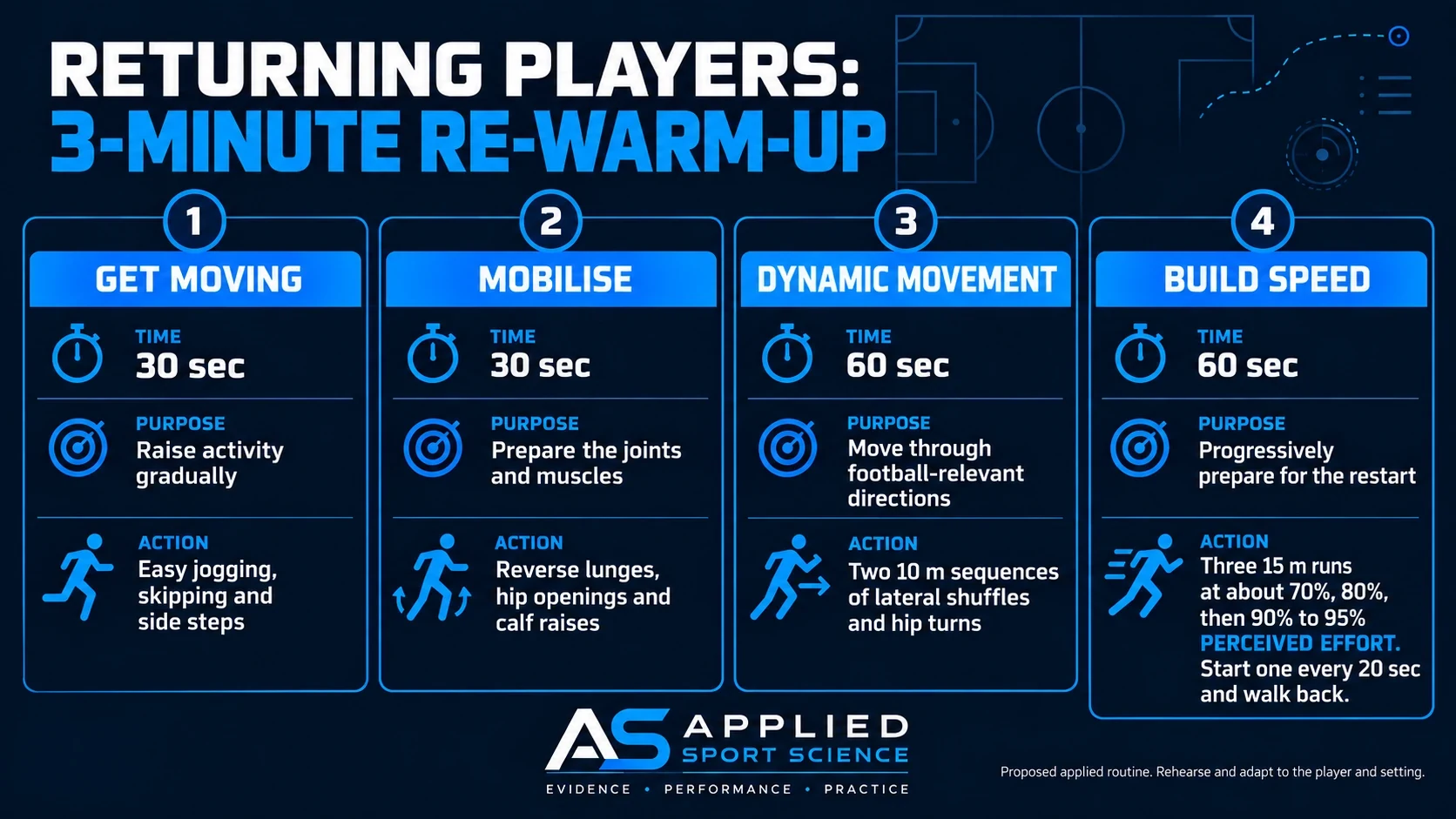
Keeping the returning players warm: I have created the following training routine for them. Again, I have made it an applied protocol, not research-tested, the goal is simply to keep the returning players warm over a short, progressive period while, also including the substitutes involved to stay ready in case they have to come on.
Returning players: There is 3 minute re-warm up before kicking of the 2nd half.
Move (30 secs). Jog lightly, skip around the floor or try side steps.
Mobilise (30 sec). 3x8 RVC. Hips stretch on each side. Calf rises.
Dynamic Movement (60 secs). Perform two 10m sequences of lateral shuffles with 180° hip turns between them.
Build Speed (60s): 3x15m (70% -> 80% -> 90-95%), starting 20s apart. Recover on the way back.
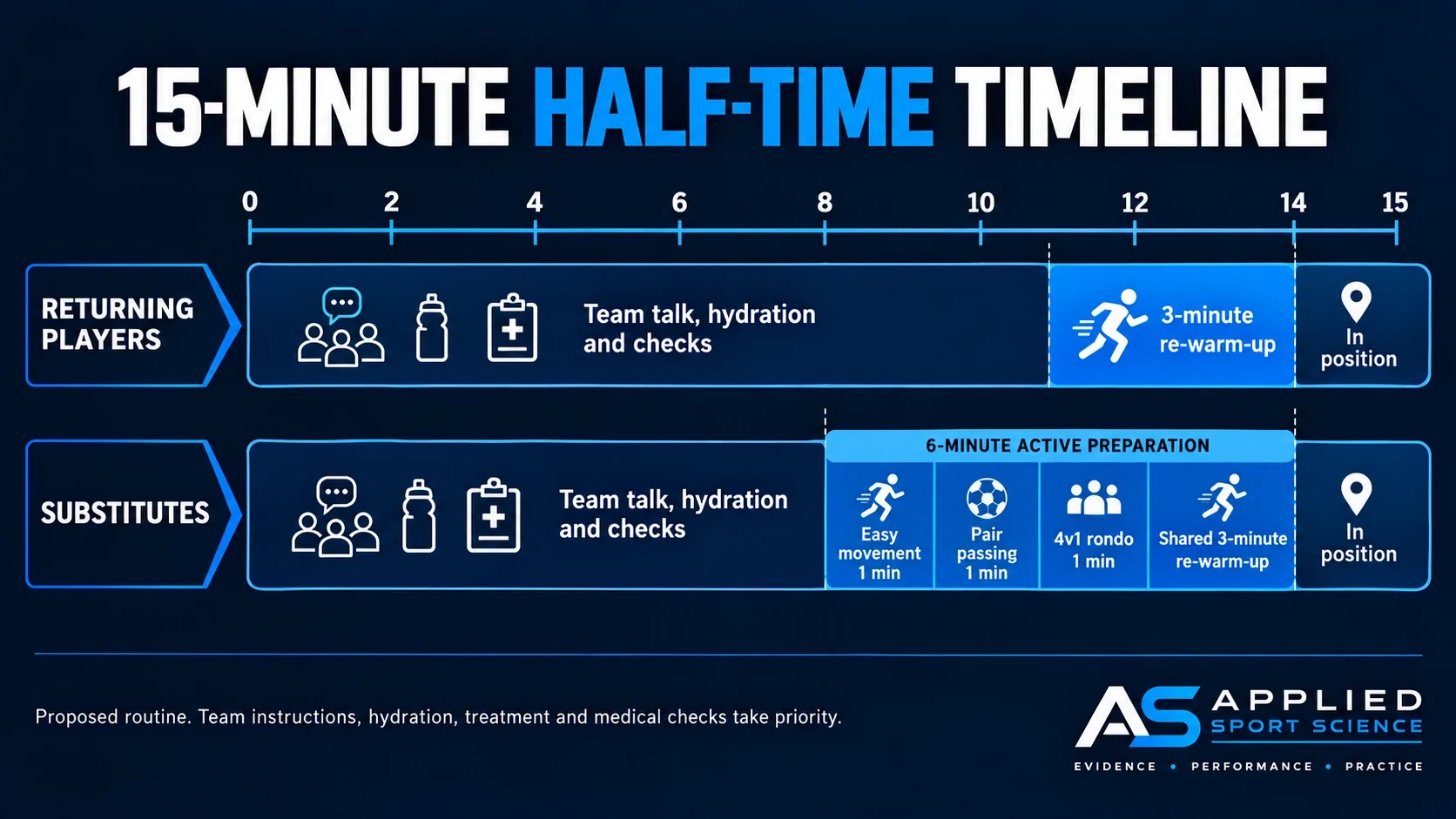
Substitutes: The substitutes have a 6 min routine. Come out from changing room at about 8 minutes. Have them get into running strides for 1 minute. Then put them into passing in pairs for 1 minute. They then perform a controlled 4 v 1 rondo for 1 minute. They then repeat the 3 minutes with the players restarting the 2nd half.
Players love to get a feel for the ball, so having some ball work makes the warmup feel much more applicable. No one has really come up with the correct amount yet.
The players form set up at to start the 2nd half around the 14 minute mark.
The objective cue is basic: come through feeling warm and fresh with your breathing in check. Percentages are effort. Do not obsess about the GPS numbers.
How I'd judge it
I guess you need practice in training, so practice that before a game. If you go with 4 games, you will have a basic chart.
Did it happen? How long did that take?
The restart completed at its scheduled time.
Hydration, medical checkup and team talk were left off, though?
Did the players really reach a plateau and feel unnecessarily fatigued?
When did the substitutes become aware that they might be subbed in?
We will know if the half-time fit is reasonable, if the players know it well and if it interferes with non-essentials. A study using real data or players could evaluate whether this halftime activity improves game performance or the prevention of injuries. However, this log alone would never determine anything about improvements.
The takeaway
We have few facts about the subject and there is no correct sequence. However, research gives the recommended guideline for exercise sequences: do not rest too long between movements, do what you already know well and increase difficulty slowly.
Having 3 minutes for substitutes and being in position for restocked players might be manageable. If 3 minutes means no disruption to the referee's advice, team talks, drinking breaks or treatments, I am for trying it.
References
- Abade, E., Sampaio, J., Gonçalves, B., Baptista, J., Alves, A. & Viana, J. (2017). Effects of different re-warm up activities in football players' performance. PLOS ONE, 12(6), e0180152. Open paper ↗
- Abreu, M., Nakamura, F. Y., Carvalho, T., Silva, D., Vasconcellos, F. & Afonso, J. (2025). Warm-up strategies at halftime: A pilot randomized controlled trial in a professional women's soccer team. Journal of Functional Morphology and Kinesiology, 10(3), 270. Open paper ↗
- Abreu, M., Nakamura, F. Y., Carvalho, T., Silva, D. & Afonso, J. (2026). Should soccer players re-warm-up at half-time? An exploratory randomized controlled trial in a professional women's team. International Journal of Sports Physiology and Performance, 21(6), 734–741. Open paper ↗
- Edholm, P., Krustrup, P. & Randers, M. B. (2015). Half-time re-warm up increases performance capacity in male elite soccer players. Scandinavian Journal of Medicine & Science in Sports, 25(1), e40–e49. Open paper ↗
- Fashioni, E., Langley, B. & Page, R. M. (2020). The effectiveness of a practical half-time re-warm-up strategy on performance and the physical response to soccer-specific activity. Journal of Sports Sciences, 38(2), 140–149. Open paper ↗
- Hills, S. P., Barrett, S., Hobbs, M., Barwood, M. J., Radcliffe, J. N., Cooke, C. B. & Russell, M. (2020). Modifying the pre-pitch entry practices of professional soccer substitutes may contribute towards improved movement-related performance indicators on match-day: A case study. PLOS ONE, 15(5), e0232611. Open paper ↗
- Mohr, M., Krustrup, P., Nybo, L., Nielsen, J. J. & Bangsbo, J. (2004). Muscle temperature and sprint performance during soccer matches: beneficial effect of re-warm-up at half-time. Scandinavian Journal of Medicine & Science in Sports, 14(3), 156–162. Open paper ↗
- Skinner, B., Munn, E. E., Roberts, T., Reed, R. A. & Thorpe, R. T. (2026). The effectiveness of passive half-time interventions on simulated second-half performance in elite youth soccer players. Journal of Sports Science and Medicine, 25(3), 617–626. Open paper ↗