
Most footballers lift. Fewer can tell you why.
Ask a player what their gym session is for and you'll probably hear something like, get stronger, faster, more powerful, fewer injuries. Sometimes it's just "because it's on the plan". Those goals overlap, but they're not the same thing. Mixing them up is how I often see good programmes drift into busy work.
So, let’s start with a better question: what quality are we building, and where will the player show it on the pitch?
What lifting actually gives you
Football is a force game. Players accelerate, jump, brake, turn and fight for space, repeatedly. Strength sits underneath all of that. Now, it isn't the only factor. Sprint skill, coordination, timing and decisions matter just as much.
The research backs lifting as a real contributor. Football reviews show consistent gains in strength and jumping. Some studies also show short-sprint improvements, mostly when heavier work is paired with more explosive actions. A meta-analysis of complex training (heavy work combined with a biomechanically similar explosive movement), in male players aged 14 to 23 found better sprint, jump and change-of-direction scores, although the evidence base was small (Silva et al., 2015; Thapa et al., 2021).
Method matters too. One trial compared fast, light-load lifting, with lifting plus plyometrics. Both worked, but differently across different tests (Rodríguez-Rosell et al., 2017). The lesson here isn't that one method wins. It's that both the intent and target drive the outcome.
Why the gym won't do the job for you
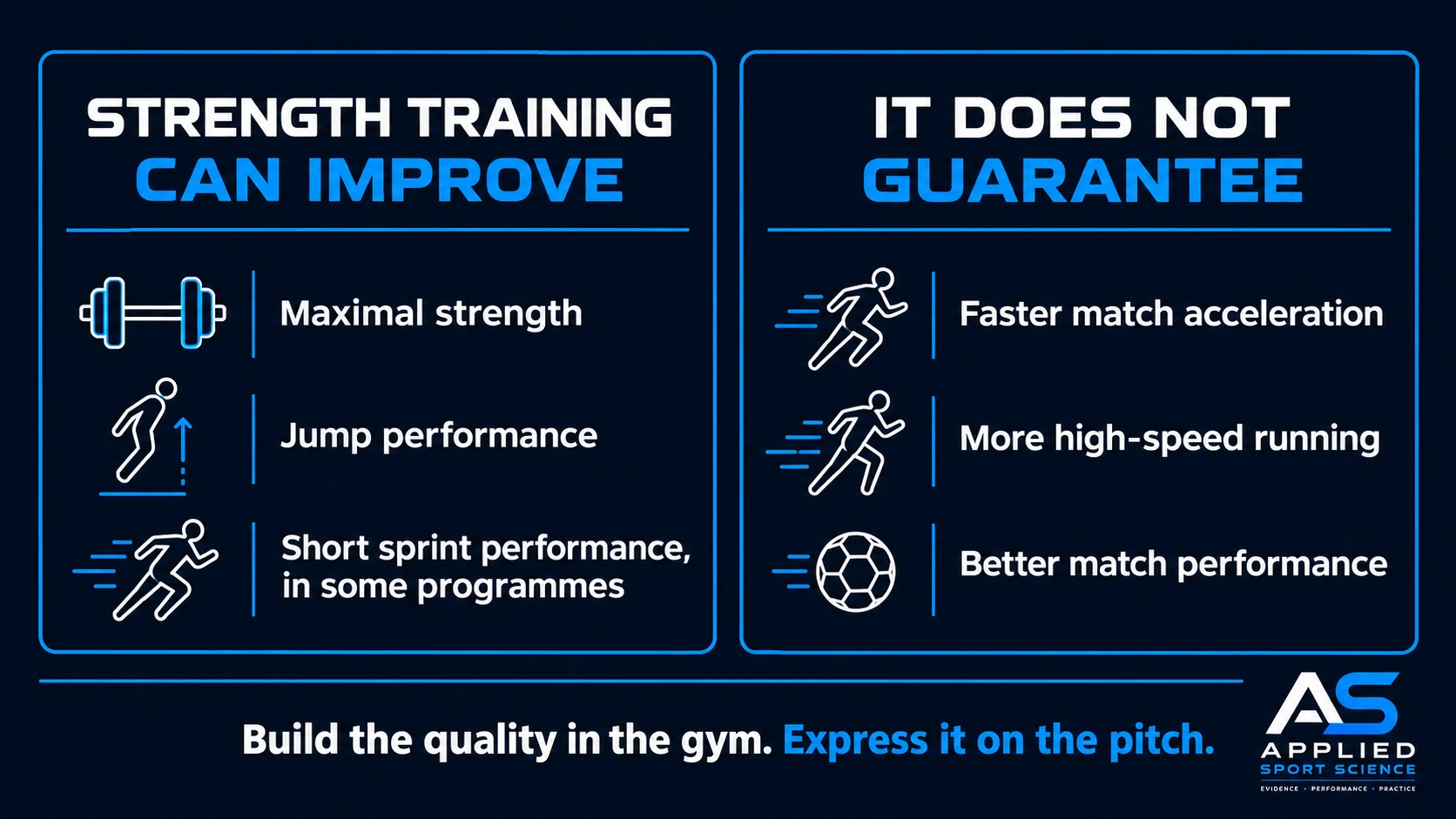
So, this is the bit that often gets missed. A stronger squat is a training outcome. It isn't faster acceleration in a match.
If you want players quicker over five metres, they must sprint. If you want them jumping higher, they must jump. Of course, braking and cutting also need practice at speed. It doesn't replace them.
The same goes for match data. A player can add 20 kg to their trap-bar deadlift and cover no more high-speed distance on a Saturday. Match running depends on role, opposition, possession, minutes and how the team plays. So, unless a study isolates lifting and measures match output, crediting the gym for a GPS change is pretty much down to guesswork.
Build the quality in the gym. Express it on the pitch. You need both.
Fitting it around football
The best programme is the one a player can sustain alongside training, speed work and matches. A big, grinding session isn't better than a smaller one that lands in the right place.
In pre-season or a development block, two strength sessions a week is a sensible starting point. In-season, you can usually get away with less. In one study of professional players, a single weekly session held on to strength and sprint gains through the first 12 weeks of the season (Rønnestad et al., 2011). Although the study was small, it offers a useful reference point for considering an in-season maintenance dose.
A lean in-season session might look like this:
- Bilateral: trap-bar deadlift or squat
- Single leg: split squat or step-up
- Hinge: Romanian deadlift
- Explosive: a few low-volume jumps
- Targeted: hamstring and adductor work where the player needs it
Two or three hard sets of 3 to 6 reps on the main lifts, stopping with a rep or two in the tank, is enough to maintain strength. Choose exercises that suit the player's experience, injury history and kit. More exercises don't make a better session.
Above all, protect sprinting. If heavy legs are blunting the week's key speed work, the gym is getting in the way. Some teams stack strength on their high-intensity day to keep recovery days clean. Others may split them. I always try to work backwards from the match.
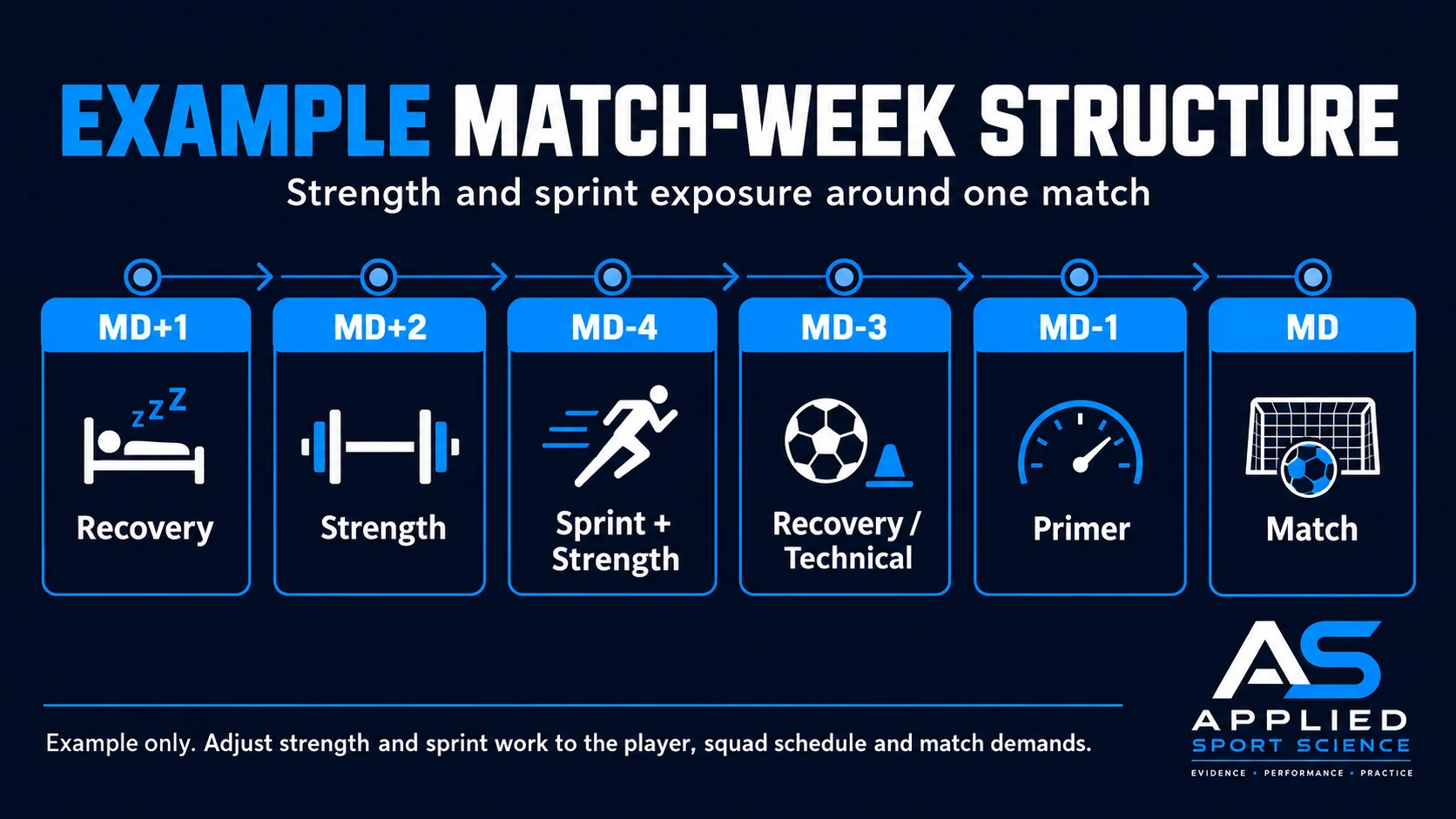
In practice, I’d place the main strength session where it can be completed with good quality and recovered from before the match. Keep later sessions shorter and adjust the dose to the player’s minutes, training load and response.
A word on academy players
Young players aren't small adults. Training age and maturation vary hugely within one age group, and two 14-year-olds can need completely different programmes. Long-term development models recommend matching training to the player's maturity and experience, not their birth certificate (Lloyd and Oliver, 2012).
Resistance training is considered safe and effective for young players when it's well supervised and properly progressed (Lloyd et al., 2014). For most academy players, the first job is often movement quality and regular exposure, and not heavy loads. Earn the right to progress.
Keep a close eye on players during growth spurts. In a small study of academy footballers, injury rates rose in the year around peak height velocity, the period of fastest growth (van der Sluis et al., 2014). That's the time to manage load carefully, not push it.
Injury prevention: helpful, not a guarantee
Strength work builds tissue capacity. No exercise makes a player injury-proof.
The Nordic hamstring exercise has been tested in football, and one trial in amateur players found fewer hamstring injuries (van der Horst et al., 2015). However, a later reappraisal by Impellizzeri et al. (2021) found the pooled evidence inconclusive, so the size of any preventive effect remains uncertain. Worth doing. Not magic.
Adductor strengthening has similar support. A large trial in male players found fewer self-reported groin problems with a simple adductor programme (Harøy et al., 2019). Evidence in women, youth and elite players is thinner.
Structured warm-up programmes such as FIFA 11+ cut overall injury rates by around 39% in recreational and sub-elite football (Thorborg et al., 2017). That's the whole programme, though, not strength training on its own.
How to tell if it's working
Before adding or changing anything, I would always ask four questions:
- What quality are we trying to build or hold?
- Where will the player express it on the pitch?
- Does the session fit around matches, sprinting and recovery?
- What will tell us it's working for this player?
Then track what you can: attendance, load, minutes, sprint exposure, how the player feels, and repeated strength or jump tests. Read them together. One test is a snapshot, not a verdict!
The takeaway
Lift to build strength. Sprint, jump and cut to use it. Adjust the dose to the calendar, and keep watching the player, not just the numbers on the bar.
A bigger squat is a good thing. It just isn't the whole story.
References
- Harøy, J. et al. (2019). The Adductor Strengthening Programme prevents groin problems among male football players: a cluster-randomised controlled trial. British Journal of Sports Medicine, 53(3), 150–157. View paper ↗
- Impellizzeri, F. M., McCall, A. and van Smeden, M. (2021). Why methods matter in a meta-analysis: a reappraisal showed inconclusive injury preventive effect of Nordic hamstring exercise. Journal of Clinical Epidemiology, 140, 111–124. View paper ↗
- Lloyd, R. S. and Oliver, J. L. (2012). The Youth Physical Development Model: a new approach to long-term athletic development. Strength and Conditioning Journal, 34(3), 61–72. View paper ↗
- Lloyd, R. S. et al. (2014). Position statement on youth resistance training: the 2014 International Consensus. British Journal of Sports Medicine, 48(7), 498–505. View paper ↗
- Rodríguez-Rosell, D. et al. (2017). Effects of light-load maximal lifting velocity weight training vs. combined weight training and plyometrics on sprint, vertical jump and strength performance in adult soccer players. Journal of Science and Medicine in Sport, 20(7), 695–699. View paper ↗
- Rønnestad, B. R., Nymark, B. S. and Raastad, T. (2011). Effects of in-season strength maintenance training frequency in professional soccer players. Journal of Strength and Conditioning Research, 25(10), 2653–2660. View paper ↗
- Silva, J. R., Nassis, G. P. and Rebelo, A. (2015). Strength training in soccer with a specific focus on highly trained players. Sports Medicine – Open, 1, 17. View paper ↗
- Thapa, R. K. et al. (2021). Effects of complex training on sprint, jump, and change of direction ability of soccer players: a systematic review and meta-analysis. Frontiers in Psychology, 11, 627869. View paper ↗
- Thorborg, K. et al. (2017). Effect of specific exercise-based football injury prevention programmes on the overall injury rate in football: a systematic review and meta-analysis of the FIFA 11 and 11+ programmes. British Journal of Sports Medicine, 51(7), 562–571. View paper ↗
- van der Horst, N. et al. (2015). The preventive effect of the Nordic hamstring exercise on hamstring injuries in amateur soccer players: a randomized controlled trial. The American Journal of Sports Medicine, 43(6), 1316–1323. View paper ↗
- van der Sluis, A. et al. (2014). Sport injuries aligned to peak height velocity in talented pubertal soccer players. International Journal of Sports Medicine, 35(4), 351–355. View paper ↗