

Here is a scenario: A player finishes Saturday’s match with very little sprint distance on the GPS report. What happens next?
It is tempting to treat the number as an instruction: the player hasn’t done enough sprinting, so add lets add some sprinting to the next session. But that number doesn’t tell us the whole story. It really depends on how sprinting was defined, what the player did in the match and during the training week, and what the coming week looks like.
The better question may be: what sprint exposure does this player need this week?
Intuitively, we already likely know that there is no single weekly target that answers that for every player. The useful work here is understanding what the player has done, what they may have missed, and what the next few days allow.
First, what does “sprint exposure” mean?
So, when we talk about sprint exposure, what we really mean is the distance a player covered above a chosen speed. That sounds straightforward, but the chosen threshold matters.
Some systems use a fixed speed, such as more than ~25.2 km/h. Others use a percentage of a player’s maximum speed. These approaches can produce different sprint distances from the same match. In one study of 20 elite male players, the distance classified as sprinting changed considerably depending on the threshold used. The fixed threshold also represented different percentages of each player’s peak match speed (Silva et al., 2024).
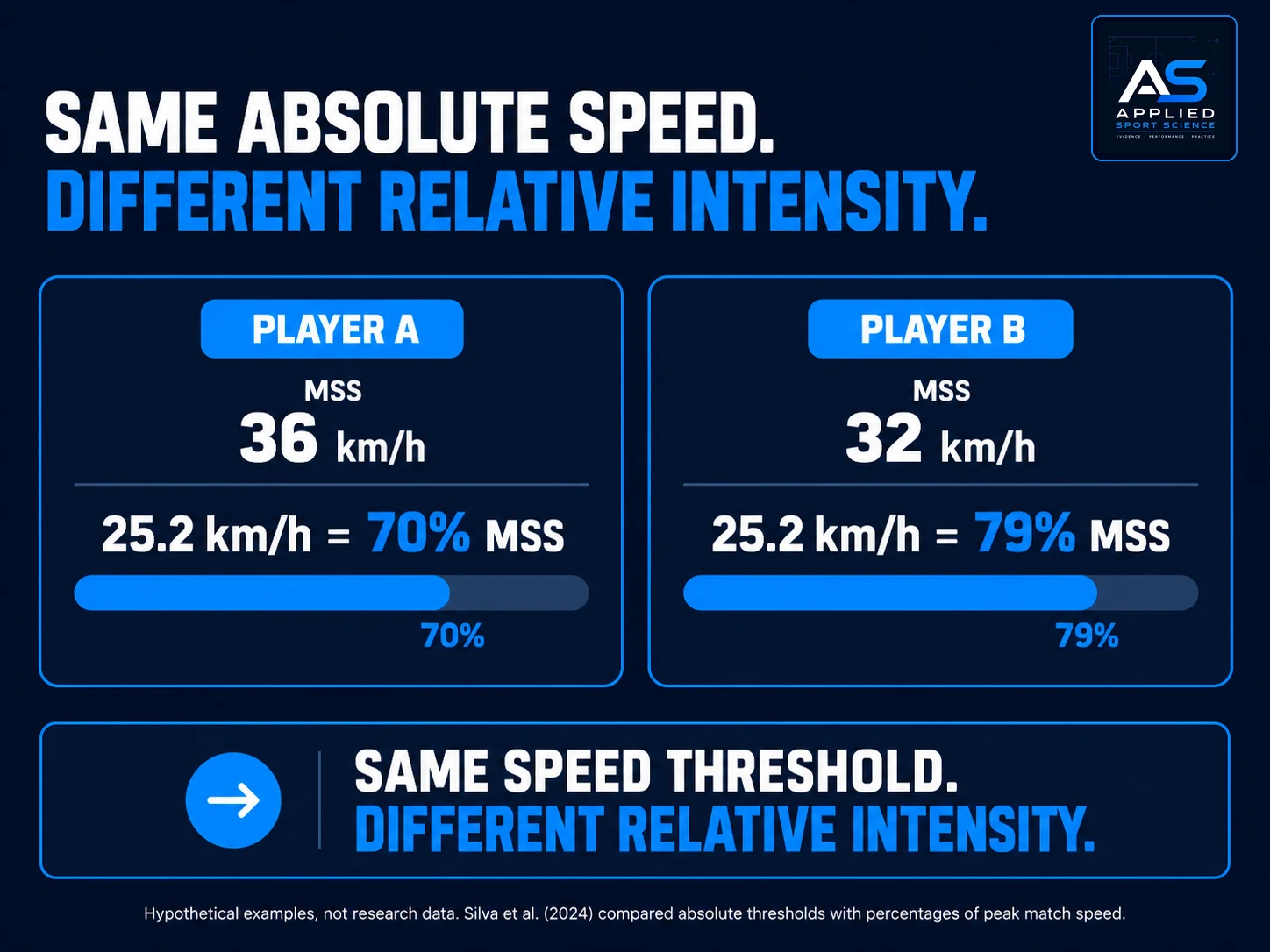
This does not mean one method is automatically right and the other is necessarily wrong. It means we need to know what a figure represents before using it to guide a decision.
Evidence: Research shows that sprint totals depend on how that sprinting is defined. A systematic review found NO consensus on the absolute speed thresholds used in professional football (Gualtieri et al., 2023).
Applied interpretation: GPS total is useful information, but it is not a complete account of the stimulus. If we compare players or weeks, we need to check that the measure and threshold make sense for the question we are asking.
A match does not give every player the same exposure
Obviously, starting player who completes 90 minutes has many different sprinting opportunities from a substitute who plays for the last 15 minutes. But even players with similar minutes may have different roles and movement demands.
That is one reason a player’s match total should be read in context. Minutes played matter, but they do not tell us exactly how much sprinting happened. Position, match events and the players’ movements all contribute massively.
And the same issue appears in training. A session might involve games with plenty of space, but players will not all reach the same speeds or cover the same distances. A review by Dello Iacono et al., (2022), suggested that sided games vary in sprint exposure substantially between sessions and players. The pitch area, game format and speed threshold all influenced the results.
Now, no doubt, games remain valuable. They develop football actions in a football context. But if the purpose is to ensure that players reach a particular speed, its unlikely games session alone will ensure players reach higher speeds.
Applied interpretation: If sprint exposure matters for an individual player, check the player’s actual exposure. Do not assume that the drill or session produced the same stimulus for everyone.
Look across the week, not at one number
Imagine two players who both record a low sprint distance in a match. One completed the full game, trained at high speed earlier in the week and has another match in a few days. The other played only briefly and had barely any exposure to high-speed running.
The same match figure does not necessarily lead to the same decision. Their preceding training, playing time and upcoming schedules differ.
That is the point of asking what the player needs this week. It encourages us to look at the whole picture rather than react to one match report.
A season-long study of 20 male professional players found that sprint measures varied across three-, four- and five-day microcycles (Gualtieri et al., 2024). This describes what happened in one professional setting. It doesn’t, however, tell us the ideal sprint day or dose for every team.
A 2026 randomised crossover study compared a high-volume repeated-sprint session on MD-4 and MD-3 in 17 male professional players. Now, interestingly, soreness was higher after the MD-3 session at the measured follow-up. That is useful information about this protocol and how players responded. It does not establish a universal rule that all sprint work belongs on MD-4, or that all sprint sessions have the same recovery cost (García-Santamaría et al., 2026).
Applied interpretation: The fixture schedule gives us the framework. Within it, the timing and type of sprint exposure need to fit the player and the session. High-volume repeated sprints and a small number of high-quality fast runs are not interchangeable.
Games can contribute, but they do not guarantee the dose
As we know, larger-sided games, with their bigger pitch dimensions, provide more opportunities to run at higher speed. A review of professional football research found that larger formats may produce meaningful high-speed and sprint exposure and suggested combining game-based work with running or circuit drills when appropriate (Gualtieri et al., 2023).
However, the same review noted that the unpredictable nature of games can lead to some players receiving more exposure and others less. The separate review of sided games also found poor reliability in the sprint and high-speed running players accumulated across sessions (Dello Iacono et al., 2022).
This is not an argument against games. It is a reminder to match the method to the aim. If we want football practice, games are central. If we also need to check whether an individual player has reached a planned speed exposure, we may need to look at the data and decide whether another method is appropriate.
Applied interpretation: Use games for what they offer, then review what each player actually did. Do not treat a game format as a guarantee of sprint exposure.
Does more sprinting reduce injury risk?
Ok, so this is the most contentious area of the post. This is also where we need to be careful. Sprint exposure is often discussed as though a specific amount will protect players from injury, the so-called “Vaccine effect”, or a sudden sharp increase will cause one.
The evidence does not support either certainty. A 2026 systematic review of 22 observational soccer studies found that short-term increases in sprint or high-speed running exposure was more often associated with higher injury risk. Studies examining absolute weekly volumes, however, more often reported negligible or inconsistent associations. The review found no reproducible dose threshold, and rated the overall risk of bias as high in 20 of the 22 studies (Xie and Cai, 2026).
These studies can identify patterns worth investigating. But they cannot show that a particular sprint total caused an injury, or indeed a specific dose will prevent one.
Applied interpretation: I would always consider recent exposure as one part of the player’s situation, alongside symptoms, injury history, training, match demands and individual response. Do not use a GPS number on its own to predict injury or decide that a player is safe.
A practical question for the next training week
Before adding sprint work, I would ask the following:
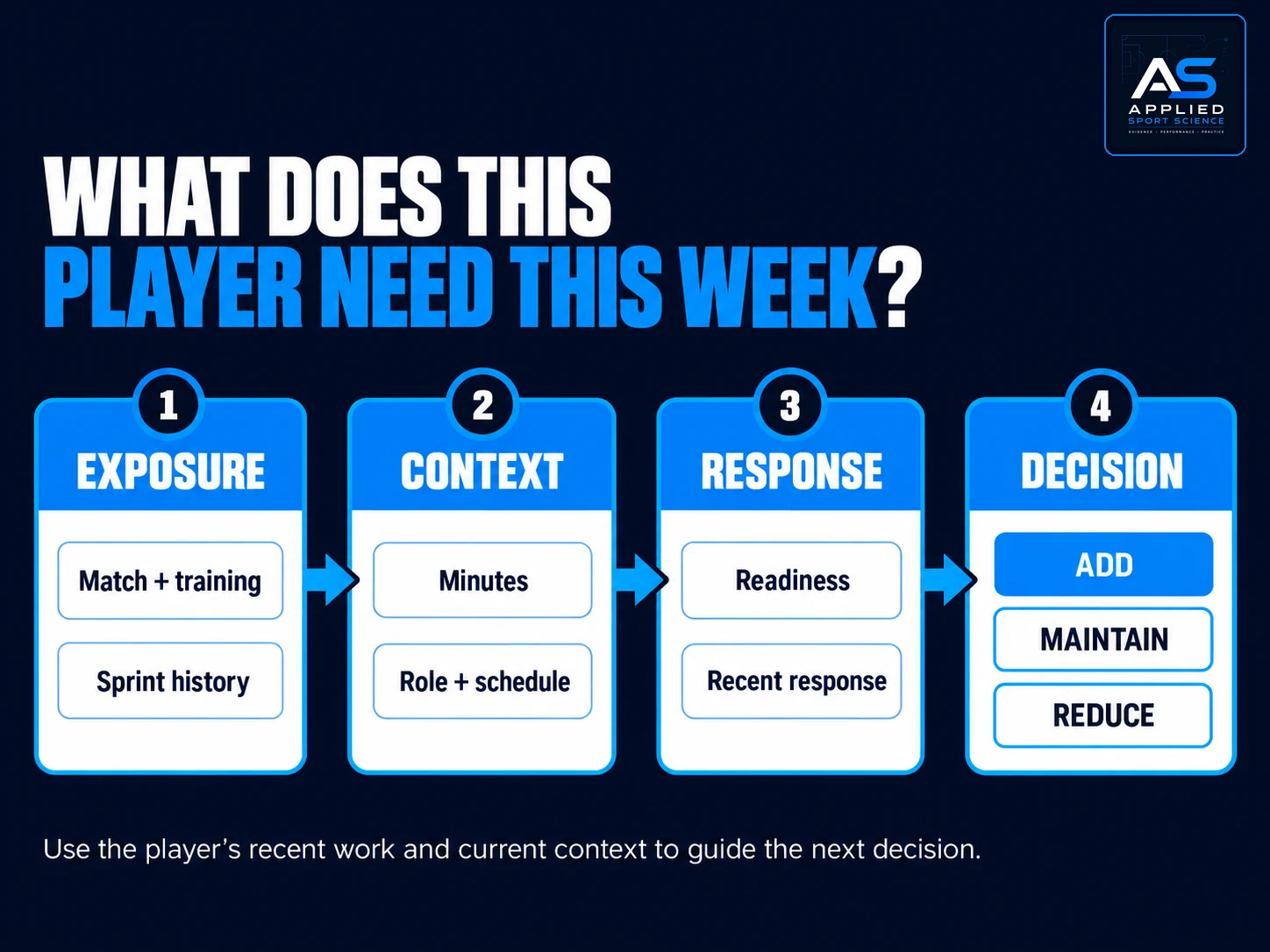
- What sprint measure are we using, and what threshold does it represent?
- What exposure did the player receive in matches and training?
- How much did they play, and what did their role demand?
- What opportunities are available before the next match?
- What type of sprint exposure is relevant to the aim?
- How has the player responded to recent training?
For sure, these questions will not calculate a perfect dose. But they can help the staff make a more informed decision and explain why a player’s plan differs from a team-mate.
For one player, the answer may be that recent match, and training exposure is already sufficient. Another may have missed much of the match and had limited high-speed work. A third may need a different approach because of their current condition or schedule. Those are examples of how context can shape a decision, not fixed prescriptions.
The takeaway
Sprint exposure is worth monitoring, but the number does not make the decision for us.
Thresholds change the figure. Match minutes and roles change the opportunity. Football drills vary in the exposure they provide. The microcycle affects when work can fit, while injury research has not established a universal safe or protective dose.
So, before adding sprints because a report looks low, ask the more useful question:
What sprint exposure does this player need this week, given what they have done and what lies ahead?
As much as we would perhaps like it to, the research cannot give us one number for everyone. It can help us ask better questions, interpret the data more carefully and make the next decision with the player in mind.
References
- Dello Iacono, A. et al. (2022). Quantifying exposure and intra-individual reliability of high-speed and sprint running during sided-games training in soccer players: a systematic review and meta-analysis. Sports Medicine, 53, 371-413. https://doi.org/10.1007/s40279-022-01773-1
- García-Santamaría, A. et al. (2026). Scheduling repeated-sprint training on different microcycle days in professional soccer players: a randomized crossover study. Journal of Strength and Conditioning Research. https://doi.org/10.1519/JSC.0000000000005572
- Gualtieri, A. et al. (2023). High-speed running and sprinting in professional adult soccer: current thresholds definition, match demands and training strategies. A systematic review. Frontiers in Sports and Active Living, 5, 1116293. https://doi.org/10.3389/fspor.2023.1116293
- Gualtieri, A. et al. (2024). Three-, four-, and five-day microcycles: the normality in professional football. International Journal of Sports Physiology and Performance, 19(10), 987–995. https://doi.org/10.1123/ijspp.2024-0144
- Silva, H. et al. (2024). Analyzing soccer match sprint distances: a comparison of GPS-based absolute and relative thresholds. Biology of Sport, 41(3), 223-230. https://doi.org/10.5114/biolsport.2024.133663
- Xie, Y. and Cai, X. (2026). High-speed running and injury risk in soccer: a systematic review. Frontiers in Public Health, 14, 1798241. https://doi.org/10.3389/fpubh.2026.1798241